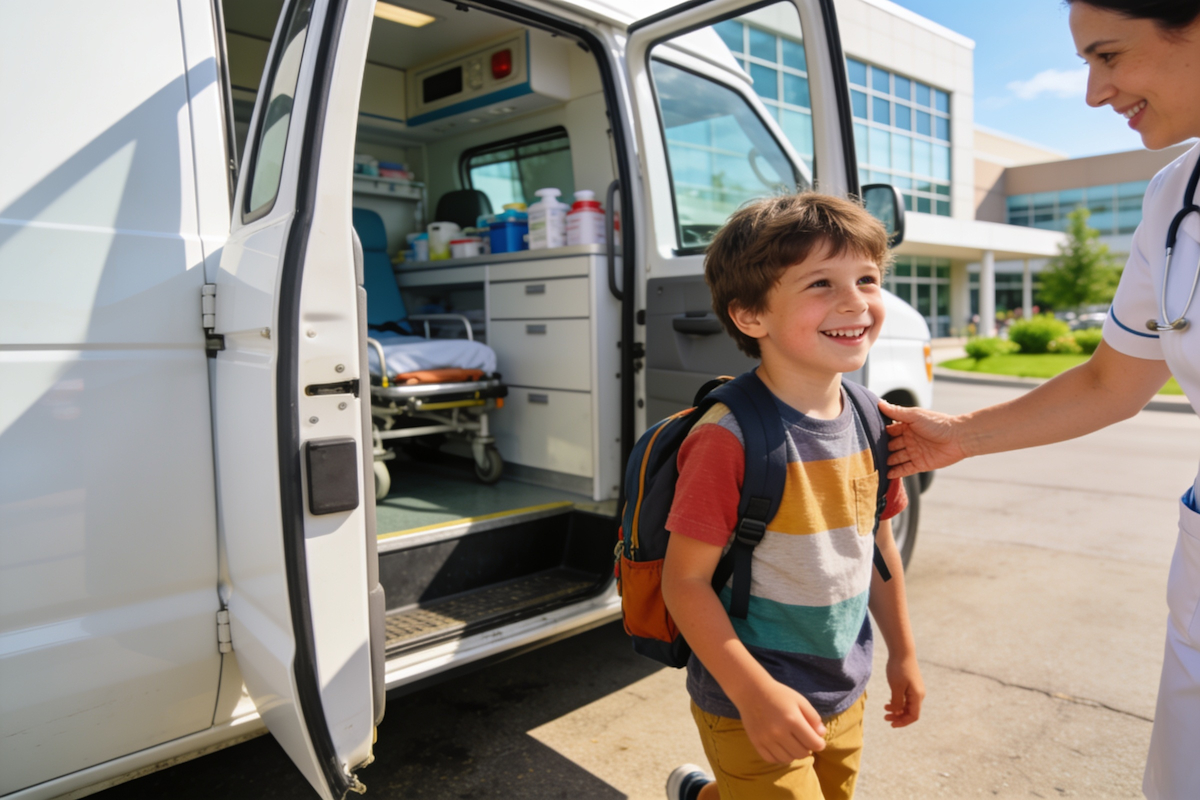
Why offer transport assistance support?
Transport assistance is not a “nice-to-have.” It is a core component of comprehensive childhood cancer care. It directly impacts survival rates, equity of access, financial protection, emotional well-being and ensuring Access to Life-Saving Treatment.
Paediatric cancer treatment involves regular hospital visits for chemotherapy, radiation, surgery, and follow-ups. Many families live far from tertiary oncology centres. Transport support ensures children arrive on time for treatment cycles, prevents missed or delayed appointments, (which can reduce survival rates) and supports adherence to strict treatment protocols.
In paediatric oncology, consistent treatment adherence is linked to better outcomes to improving survival and health outcomes. Interruptions in care can lead to disease progression or relapse and transport assistance helps maintain continuity of care and enables quicker response to complications or emergencies.
Transport assistance helps to alleviate the financial burden cancer treatment already places on families. Many caregivers must stop working or lose income and travel costs (fuel, taxis, buses, accommodation) can be overwhelming. Transport support reduces catastrophic out-of-pocket expenses.
Paediatric oncology treatment centres - especially in low- and middle-income countries (LMIC) are specialised oncology services and often centralised in urban areas. Rural and low-income families face long distances and poor transport infrastructure. In most LMIC interhospital transport is unreliable or non-existent. Transport assistance promotes equitable access to care, regardless of geography or income.
Travel stress can negatively affect emotional and psychosocial well-being for both the child and caregivers. Reliable transport reduces anxiety about getting to hospital and minimises physical exhaustion for already vulnerable children. Transport assistance allows families to focus on care and recovery rather than logistics.
Transport is one of the most cited barriers to adherence in childhood cancer programmes. Transport assistance enhances treatment adherence and programme success. Transport assistance improves attendance rates, strengthens overall programme effectiveness and outcomes, and helps healthcare providers plan and deliver care more efficiently.
Beyond medical treatment, children often need psychosocial support, nutritional services and rehabilitation and follow-up care and transport assistance enables access to holistic care, which is essential in paediatric oncology.
Globally, one of the biggest challenges in childhood cancer, especially in LMIC countries, is treatment abandonment and lack of transport is a leading cause. Providing transport can significantly reduce dropout rates.
WHO WILL BENEFIT FROM TRANSPORT ASSISTANCE SUPPORT?
Transport assistance for children with cancer creates a wide circle of benefit—far beyond the patient alone. It strengthens the entire care ecosystem, from families to health systems.
Children, adolescents and young adults diagnosed with cancer are the primary beneficiaries and the centre of care. Transport assistance will enable them to attend life-saving treatments consistently and on time, experience less physical strain from long, difficult travel, have improved treatment outcomes and survival chances and reduced anxiety about getting to hospital.
Parents and caregivers carry the practical and emotional burden of treatment. Transport assistance will lower financial stress (transport is often a major cost), reduce the risk of job loss or lost income, lessen the emotional strain and logistical pressure, and help them to focus on supporting the child’s care.
Cancer affects the entire household – the siblings and the extended family. There are more stable family routines when travel is supported and less financial diversion from the other children’s needs. Transport assistance reduces the emotional stress within the family unit.
Healthcare providers and hospitals benefit from more predictable patient access when patients adhere to appointments. Fewer missed treatments and delays will have better clinical outcomes, which reflect programme success and more efficient use of limited oncology resources.
Support organisations, charities or NGOs supporting children and young people diagnosed with cancer benefit directly when they can show stronger programme impact and measurable outcomes. Reduced rates of treatment abandonment enhance credibility with donors and partners when impact reports show an ability to deliver holistic care support.
Improved equity of access to specialised services, better use of public health investments, reduced long-term costs from complications or relapse due to missed care and progress toward national and global childhood cancer targets contributes to broader Health systems and government goals.
Donors and funders who invest in support programmes for childhood cancer also benefit when there is a clear, measurable impact on survival and adherence, a high return on investment, because transport assistance is a relatively low-cost but with a high-impact, and impact can be measured through tangible stories of change and improved outcomes.
Healthier children who can return to school and community life can become socio-economic independent citizens. The burden of untreated or poorly treated childhood cancer patients is reduced and trust in healthcare and support systems are strengthened. There is a broader social benefit.
WHAT SHOULD WE KNOW TO RUN TRANSPORT ASSISTANCE SUPPORT SUCCESSFULLY?
A successful transport assistance programme requires a clear need and a defined model, strong safeguarding and medical awareness, partnerships and legal compliance, sustainable funding, and a good data system. Transport assistance may be delivered through multiple mechanisms, such as direct financial support to beneficiaries, the provision of organisation-operated patient transport vehicles, coordination of inter-hospital transfers, or collaboration with like-minded organisations and partners. Many programmes use a hybrid model to remain flexible.
Before starting any programme, you need to understand the real need. A simple needs assessment or survey with families and hospitals is essential to understand where patients are travelling from, and how far, what transport options already exist (public, NGO, hospital), how often do children need to travel (daily, weekly, monthly) or what are the main barriers (cost, distance, safety, availability)?
There is not a one-size-fits-all approach and the support organisation needs to define their own transport model to suit their needs. If the foundation is going to use their own vehicles, they need to take staff (drivers), fuel, maintenance, insurance, and licence cost into consideration. If the foundation chooses to provide transport support through vouchers or cash for taxis, buses, or personal fuel, it is essential to have administrative staff, along with clear policies and procedures, in place to ensure safe, transparent, and effective management.
Collaborating with like-minded ride providers, local taxi and bus services, or dedicated shuttle operators running fixed routes between key locations and hospitals can strengthen and support the transport assistance programme.
Transparent criteria ensure fairness and trust. Demand will most likely exceed resources and clear policies and criteria are critical. Distance from the treatment centre, the treatment phase of the child (new diagnosis, intensive treatment, relapse) and the medical condition of the child (immunocompromised, mobility issues) will be a determining factor in the support to the child. A transport assistance programme might be means-assessed so that only families who cannot afford travel to the hospital receive support. This ensures the resources go to those who need them most, rather than everyone automatically. Assessment by the social worker is critical.
Transporting children is a high-responsibility service. Drivers need screening for background checks and reliable references. Child protection policies and training need to be in place. Rules about who can accompany the child must be clearly set out. Emergency contact details and procedures; as well as clear incident reporting systems should be in place and available.
Children undergoing cancer treatment are medically vulnerable. Infection control (especially for immunocompromised patients), safe travel conditions (ventilation, hygiene), protocols for medical emergencies during transport and coordination with healthcare providers for high-risk patients must be taken into consideration.
Strong collaboration with treatment centres is key and hospitals must help to identify the most vulnerable patients. Align transport schedules with treatment appointments and collaborate closely with social workers and nurses for referrals. Share communication channels for changes or emergencies.
Legal compliance protects both patients and the organisation. Road transport and licensing laws should be strictly adhered to. Insurance for the vehicle and passenger liability must be in place to protect the foundation as well as the patient. If the drivers are employed by the foundation, labour laws should be adhered to. The patient and the families’ personal data should always be protected.
Transport programmes can become costly if not professionally managed. Budget for fuel, maintenance, insurance, staffing, and plan for over time demands. Monitor cost per trip/patient to ensure efficiency and fairness. Donor funding should be sustainable.
Logistics and operations coordination can be complex and needs planning. Implement a booking and scheduling system, even a simple spreadsheet initially could ensure that route planning maximises efficiency. Clear communication with families (times, pick-up points) is important for them, but also for the foundation so that there is no misuse of the programme. Contingency plans (vehicle breakdowns, delays) must be in place and visible to everyone.
Foundations need a well-developed monitoring and evaluation plan to demonstrate impact, especially to funders. Foundations need to track the number of patients supported, trips completed, missed appointments reduced, treatment adherence rates and patient/family satisfaction. This data is critical for funding and programme improvement.
A comprehensive approach improves outcomes in paediatric oncology and transport should not stand alone but be integrated with the home-away-from-home programme such as psychosocial support, nutrition programmes, and awareness campaigns.
Avoid launching too big, too fast. Pilot in one area or hospital, evaluate your model and refine processes. Scale gradually based on demand and available resources.
READ MORE
Abdulrahman Alsultan, et al. 2020. Travel burden and geographic access to health care among children with cancer in Saudi Arabia. EMHJ-Vol 26 No. 11-12020. https://applications.emro.who.int/emhj/v26/11/1020-3397-2020-2611-1355-1361-eng.pdf
Lynn B. Edwards, et al. 2017. A descriptive qualitative study of childhood cancer challenges in South Africa: Thematic analysis of 68 photovoice contributions. SA Journal Oncology. https://sajo.org.za/index.php/sajo/article/view/14/29?utm_source
Hayley Newman, et al. 2024. Providing Groceries and Transportation to Poverty-Exposed Pediatric Oncology Families. The PediCARE Pilot Randomized Clinical Trial. JAMA Internal Medicine. https://jamanetwork.com/journals/jamanetworkopen/fullarticle/2819344?utm_source
Iris R Jooste, et al. 2024. Access to childhood cancer medicines in South Africa: a health systems analysis of barriers and enablers. PMC. https://pmc.ncbi.nlm.nih.gov/articles/PMC11249159/?utm_source
Muhammad Wasim Khan, et al. 2025. Identifying the Factors Contributing to Treatment Abandonment in Childhood Cancers at a Tertiary Care Hospital in Pakistan. Oncodaily Medical Journal. https://oncodailyjournal.com/10.69690/odmj-001-0829-4568/?utm_source
Was this article helpful?
Related Articles
I want to start a childhood cancer foundation
Many of Childhood Cancer International (CCI) members established sustainable and successful foundations. You are welcome to reach out to CCI for mentorship and knowledge sharing. You don’t need to reinvent the wheel. Remember, you are not alone and CCI is there to support and guide you.