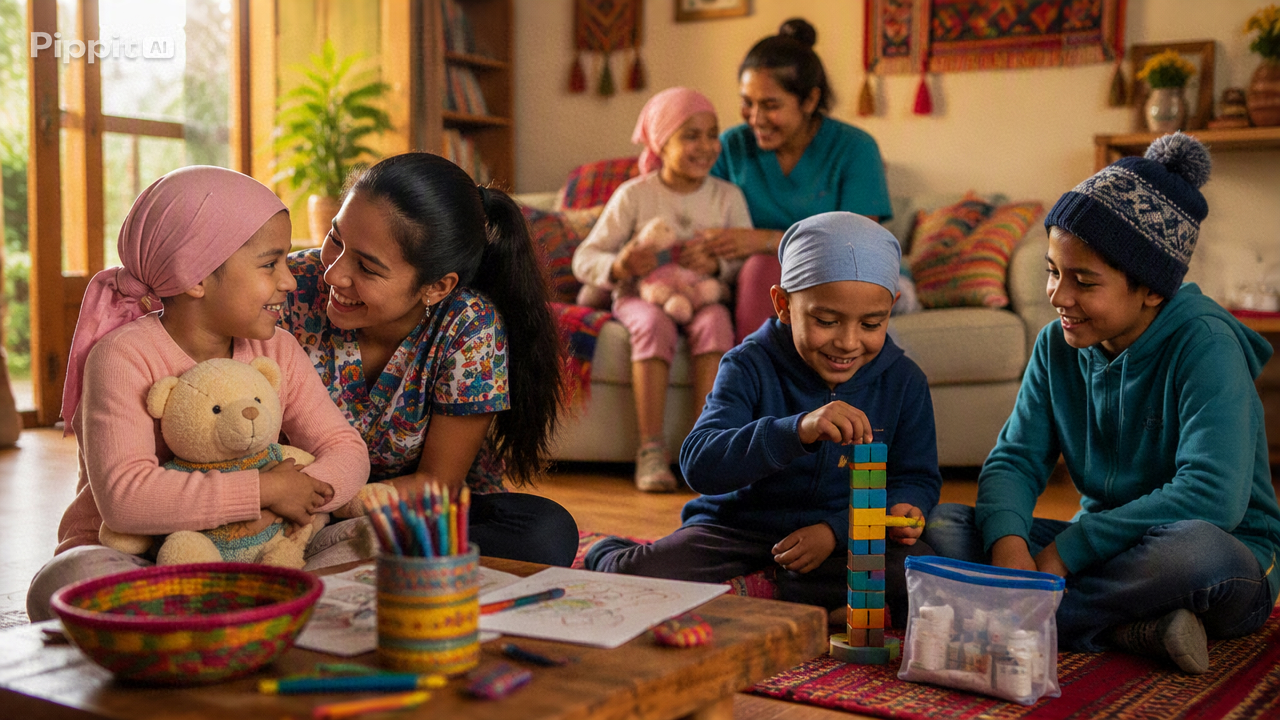
Why do childhood cancer foundations, NPOs or charities offer home-away-from-home programmes?
Accommodation ensures that children can access life-saving treatment without interruption and ultimately increase survival chances for children with cancer.
Cancer treatment often involves frequent hospital visits, chemotherapy cycles, radiation sessions, and follow-up appointments over months or years. Staying close to the treatment centre allows patients to attend appointments consistently and reduces the risk of treatment abandonment or delays.
Treatment already places a major financial burden on families. Providing accommodation helps to alleviate financial strain on the families and help them to focus on the child’s care rather than financial survival.
Home-Away-From-Home (HAFH) programmes create therapeutic and supportive residential environments where families can connect with other parents going through similar experiences, have access to counselling and psychosocial support and reduce isolation and stress during treatment.
Children undergoing chemotherapy often have weakened immune systems. In some circumstances the child’s home is not suitable to stay at when on treatment due to the risk of infections, shared ablutions, etc. Safe accommodation close to the hospital allows quick access to medical care if complications or infections arise.
Different childhood cancer foundations, NPOs or charities have different accommodation admission criteria or policies. Some foundations allow a parent or caregiver to stay with the child, or in some cases they allow families to stay with the child which is critical for emotional comfort from the parents or families, to assist with care routines and to helping children cope with treatment.
In many countries, particularly in low- and middle-income settings, long travel distances and accommodation costs are major reasons families discontinue treatment. Providing housing helps ensure treatment completion and improved survival rates.
Accommodation programs ensure families have stable living conditions during these critical stages. Children may need to stay near hospitals during intensive chemotherapy phases, stem cell transplants, radiation therapy, and early recovery periods.
Where do you start?
A childhood cancer foundation, NPO, or charity should be well established and in good organisational standing before initiating a HAFH programme. Membership in international networks such as CCI can provide valuable support, guidance, and potential access to funding opportunities.
Strong governance structures must be in place. This includes having an active and accountable board of directors or a governing body, as well as key organisational documents such as a constitution, strategic plan, organisational policies, and standard operating procedures.
The organisation should also have sound financial systems, including a registered organisational bank account and sufficient seed funding to establish and sustain the HAFH programme during its initial phase. Adequate financial planning is essential to ensure the long-term sustainability and responsible management of the accommodation service.
A feasibility study for accommodation (HAFH) for children on cancer treatment determines whether the project is needed, practical, affordable, and sustainable before it is established. The study should examine medical, operational, financial, and social factors.
1. The first step is to do a needs assessment to determine whether accommodation is actually needed. You need to ask the following questions:
- How many children with cancer are treated at the hospital each year?
- How many patients travel long distances for treatment?
- How many families currently struggle with accommodation?
- Are there treatment abandonment issues related to travel costs or distance?
This information is usually obtained from the paediatric oncology units, hospital social workers, or patient support organisations.
2. You need to do a stakeholder analysis to identify the key stakeholders who will influence or support the project, who will collaborate, refer patients, or support the programme. You will collaborate with the following stakeholders: hospitals and paediatric oncology units, government health departments, families of patients, other childhood cancer NGOs or charities, donors and corporate partners, social workers, and healthcare professionals.
3. You will need to assess the location and accessibility. Accommodation must be close enough to allow quick access to hospital treatment. Take the distance from the hospital, transport access, safety of the neighbourhood and accessibility to essential services such as shops, pharmacies, etc. into consideration.
If you want to purchase land and build an accommodation facility from scratch, you will need to find land close to the hospital. You need clearance that it can be used to accommodate patients and families according to the municipal by-laws. You might also consider purchasing an existing house or renting a premises on the hospital grounds.
4. Estimate how many families will use the accommodation through a demand and capacity analysis. The study should determine the average number of patients from outside the treatment area, average treatment duration, estimated length of stay per family and the number of rooms required. This analysis will determine the size of the facility, staffing needs and operational costs.
5. Furthermore, a feasibility study should assess the infrastructure and facility requirements for accommodation. Typical features include bedrooms, shared kitchens, living areas, bathrooms, laundry facilities, and child-friendly spaces. The design should also incorporate appropriate infection-control measures, security systems, and accessible features for children who are ill or have disabilities. Infection prevention is particularly important for immunocompromised children undergoing chemotherapy.
Short-term cost savings can lead to higher long-term expenses if infrastructure is poorly planned. It is therefore important to carefully plan essential systems such as heating, ventilation, air conditioning, plumbing, and electrical installations. Consideration should also be given to energy-efficient and sustainable building practices, including site analysis, environmental impact, and the use of environmentally responsible materials.
Integrating residential design with technical expertise—particularly professionals who understand the specific needs of the beneficiaries, such as children with disabilities or complex medical conditions—can prevent costly modifications in the future. The goal should be to create living spaces that are not only structurally sound but also adaptable to the evolving needs of beneficiaries, while meeting standards for safety, efficiency, and environmental responsibility.
6. The study should outline how the programme will operate. Many childhood cancer foundations, including members of Childhood Cancer International (CCI), successfully run HAFH facilities for years. You are not alone—CCI can provide in-house training and share valuable information that can be adapted to your country and cultural context. The key considerations should be admission criteria, referral system from hospitals, house management structure, staffing requirements and volunteer involvement.
7. The board of directors or governing body should approve financial feasibility. They should decide whether they want to keep the capital project as part of the organisation or do they choose a separate entity to protect the capital project as well as the foundation’s operational funds. It is important to have enough seeding money to start and to sustain the project.
The study should estimate the following: capital costs (property purchase or rental), renovations you might need, furniture and equipment, security systems, operational costs, staff salaries, utilities, food, maintenance, transport to hospital, occupational health, and safety.
You need to secure funding resources for sustainability from grants, corporate sponsorship, donations, or international childhood cancer organisations and do not forget gifts-in-kind (GIK) donations.
8. The feasibility study should identify all legal and regulatory requirements. This may include registration as a non-profit organisation / charity / foundation, zoning and accommodation regulations, health and safety compliance, child safeguarding policies such as the Protection of Personal Information, Children’s Acts, etc.
9. The study should assess potential risks for example how to manage insufficient funding, low occupancy, infection risks, staffing shortages, governance issues, political unrest and humanitarian crisis, climate change, and geographical instability. Mitigation strategies should be identified.
10. The feasibility study should examine how the accommodation will improve Social and Health Impact. Potential benefits include reduced treatment abandonment, improved adherence to treatment schedules, reduced financial stress on families and increased psychosocial support.
11. Lastly, the study should have a monitoring and evaluation plan with recommended indicators to measure programme success, for example, the number of families accommodated, treatment adherence rates, patient satisfaction, reduction in missed treatments, etc. Regular impact reports to donors will show good governance and success.
Read More
- Indeed Editorial Team. 2025. How to write a Feasibility Study (with tips and examples). https://www.indeed.com/career-advice/career-development/how-to-write-feasibility-studies#:~:text=Describe%20the%20project.,Describe%20the%20project
- August Brown. n.d. 5 Key Components of a Feasibility Study. https://augustbrown.com/news-item/5-key-components-of-a-feasibility-study/#:~:text=The%20five%20key%20components%20of,route%20to%20take%20moving%20forward.
- Ronald McDonald House. n.d. Learn about Ronald McDonald House-sponsored research. https://ronaldmcdonaldhouse.org/about-us/research
- Childhood Cancer Support. n.d. Accommodation Houses. https://www.ccs.org.au/how-we-help/accommodation/
- St Jude India Child Care Centres. 2026. https://stjudechild.org/approach/?utm_source
- American Cancer Society. 2025. Hope Lodge® program overview. Retrieved from American Cancer Society website: https://www.cancer.org/support-programs-and-services/patient-lodging/hope-lodge.html
Was this article helpful?
Related Articles
What is a patient support organisation?
One of the guiding principles of all those involved in childhood cancer is that the patients and their families should never feel alone in their difficult times. In 2000, Mark Chesler and Sara Eldridge launched the concept ‘You are not alone’. Internationally this term has been used by childhood cancer foundations to make parents, survivors, patients and their dear ones feel loved and cared for.

Why do we need to start a childhood cancer foundation?
Many parents who have been through the childhood cancer journey have a need to give back either to honour their child, to support other families facing the same journey, to address the unmet needs in the health system, to raise awareness about childhood cancer, to raise funds for treatment or supportive care programmes, to provide sense of purpose and healing, to build a supportive community, to advocate for the children’s rights, to fill the gap left by their own experience or the contribute to research and improved outcomes.
I want to start a childhood cancer foundation
Many of Childhood Cancer International (CCI) members established sustainable and successful foundations. You are welcome to reach out to CCI for mentorship and knowledge sharing. You don’t need to reinvent the wheel. Remember, you are not alone and CCI is there to support and guide you.